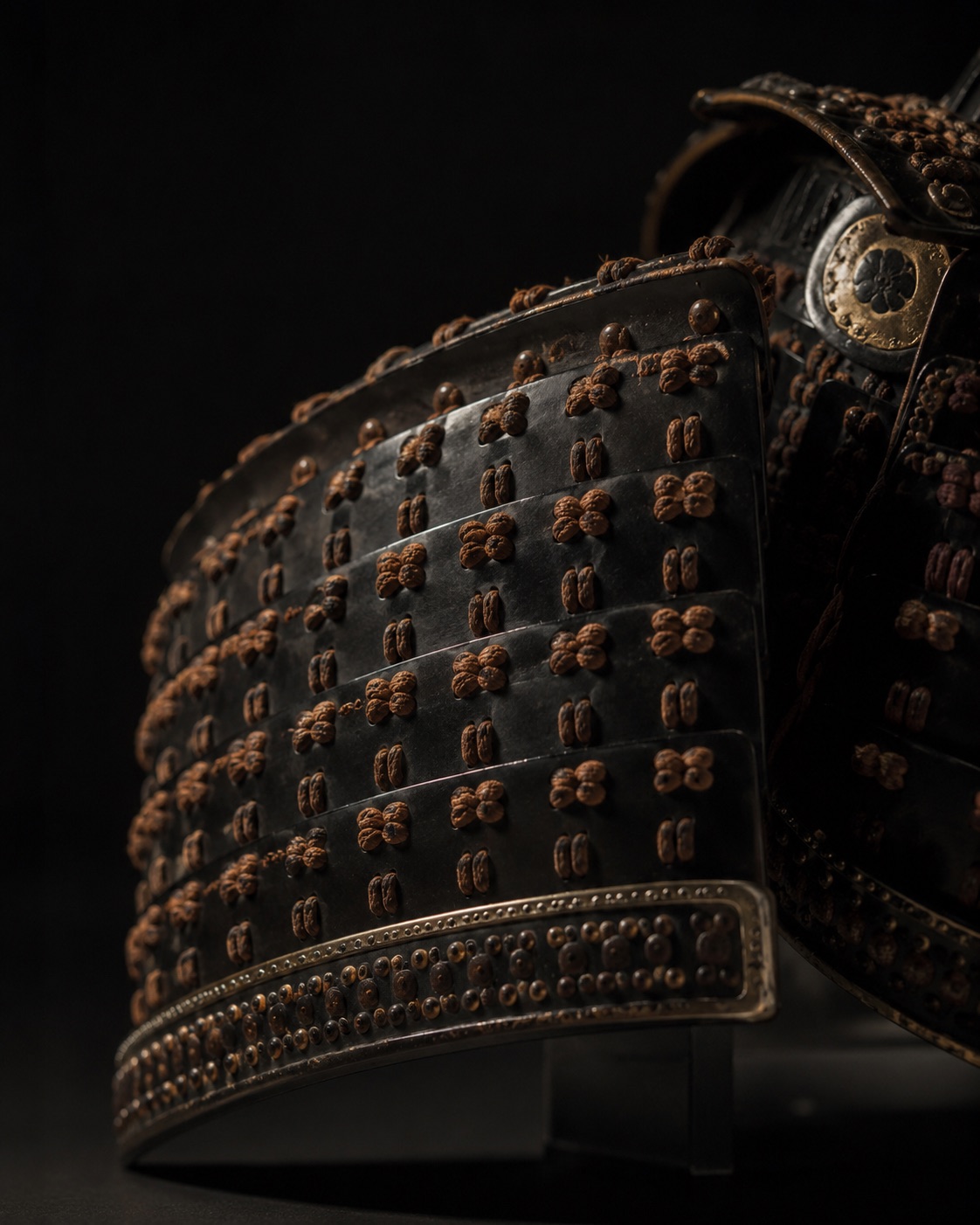
Kebiki-odoshi
Silk drawn at an even hand tension, its compact knots holding every lacquered row without stiffening the whole.
Hon-kozane
Overlapping iron and nerigawa scales lacquered separately, then bound into a flexible defensive skin.
Aged-gold kanamono
A hand-worked fitting closes the shoulder assembly; its quiet wear is kept rather than polished away.
Musubi
Craft record
Notes from the bench
Musubi begins with hon-kozane: hundreds of narrow iron and nerigawa scales, pierced to a shared pattern, overlapped, and lacquered until each row sheds water without losing its flex. The plates are deliberately quiet. Their work is to disappear beneath the rhythm of the cord.
The odoshi is braided for this armor alone. Chestnut-brown silk is sorted by twist and sheen before a single length reaches the bench, then drawn through each scale at a tension judged by hand. Too loose and the rows chatter; too tight and the armor cannot follow the body. The correct pull leaves every crossing even while the whole suit still breathes.
At the shoulder, one muted red tie records the joining of the final two assemblies. It is not an accent applied afterward, but the last structural knot—and the only moment the hand of the house is allowed to remain visible.
Provenance
The record of its making
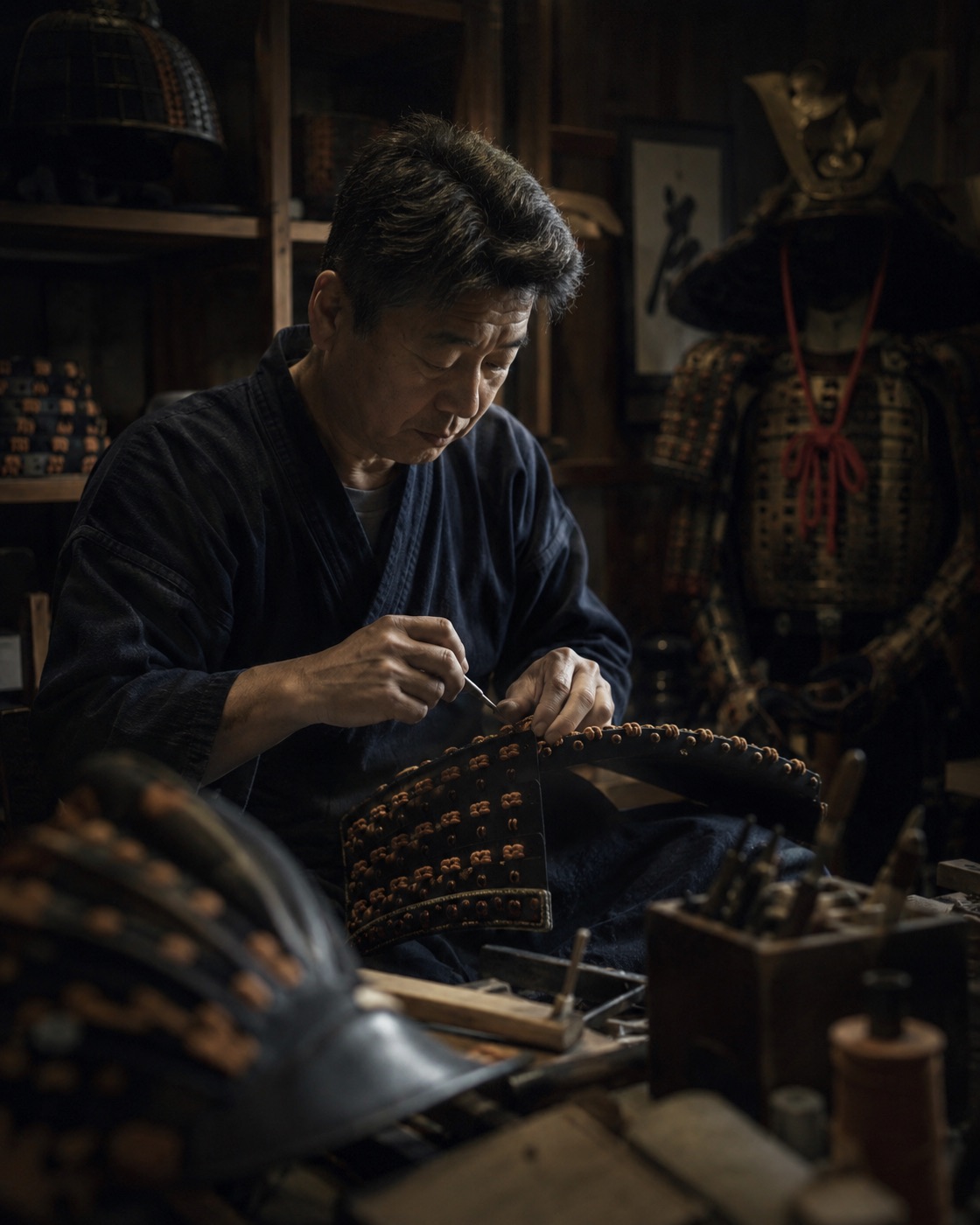
Scaled
Iron and nerigawa hon-kozane pierced and matched
January — March 2025Lacquered
Eight black grounds laid, cured, and burnished
April — September 2025Braided
Kuri-iro silk drawn and tensioned row by row
October 2025 — May 2026Sealed
Entered into the Register as Work X of XII
June 2026
Entered into the Register · Work X of XII · 2026